
Use good interview questions to avoid bad bosses.

This is a guest post by Andrew Rondeau.
You have been invited to attend an interview. You've been waiting a long time for this one.
This could be the perfect job.
The company has a great employment brand and future, and the vacancy sounds great as well. Good pay, great prospects, great perks.
This is THE job to die for. Your dream job.
You can see yourself in the job.
Free bonus: The One Job Interview Resource You’ll Ever Need is a handy reference to help you prepare for any kind of job interview. Download it free now
The big day arrives
You're prepared and have all the answers ready with all the examples, your work portfolio is in hand, you look great, are well-groomed and your clothes are sharp (that recent shopping trip will be worth it).
You're feeling confident and fully prepared.
But are you?
The relationship between managers and direct reports is a critical factor in morale, productivity and retention of high performers.
One thing which causes high stress in individuals at work is the bad management style of their boss. You get used to the pay, perks and prospects, but they become insignificant when your boss is a bad manager.
You do not get used to bad managers, especially very bad ones. Studies show that bad bosses are the number one reason people leave their jobs.
How do you define a bad manager?
We all have different definitions for the term “bad”.
Some may say their managers are bad because “I never get any praise,” others may say it's “because you never see them and they don't communicate” or because “he is so arrogant, always believing he is right and everyone else is wrong.”
Much has been written about the habits or traits of bad managers, but how do you tell if your prospective boss will be a bad one?
You are just about to be interviewed for the job of your life, but how do you know whether you'll want to work for the individual (assuming they will be your boss)?
Remember that interviews are a two-way process, as much for the potential employee's benefit as for the employer.
The job interview begins
The time for the interview has arrived.
The the prospective manager meets you in the glamorous reception 30 minutes late, their handshake is weak and clammy, and no apology is forthcoming for them being late.
In silence, they lead you to the interview room which is a few minutes walk from the reception. There is no offer of a drink.
Their smartphone goes off. It is a friend, or at least, you assume it is because they have a five-minute conversation about last night's TV, with quite a lot of swearing going on throughout.
You're thinking, “this is a test, isn't it? They're wondering how I'm going to react.” Except that it's not a test, this is how they are.
The interview starts late. Standard questions are fired at you, with no eye contact taking place. They don't even look at you when you're talking, just looking down whilst taking a few notes.
Your gut is telling you: this is not the job for you. However, you decide to give them the benefit of the doubt, as they might just be having a bad day and this isn't how they really are.
Now it is your turn to ask questions. How are you going to know if they are a great, or at least a good manager?
Here are some important questions you need to ask to get warning signs of a toxic boss.
5 interview questions to test your next boss
1) What is your management style?
Are they silent? Do they have to think about it?
Are they vague?
Do they mention words like “supportive, approachable or decision maker”?
2) Have you ever asked for feedback on your management style, and what were the results?
A good manager will always be looking to improve their performance and style and one of the best ways to do this, is to ask their staff for feedback.
If they have asked for this feedback, follow up by asking how have they used it to improve their style?

3) When was the last time you took forward an employee suggestion or idea?
Bad managers don't follow up on employee ideas.
Are they struggling in their answer?
Is the example they give worthy of a great manager?
If they do provide a worthy answer, it shows they are supportive, approachable and they listen. A great manager removes all obstacles to help their staff do the best job possible.
4) When was the last time you praised an employee or team member, and why?
If they haven't ever done this, or the examples given are weak, be wary.
Bad managers withhold praise. One of the biggest staff motivators is praise from their manager.

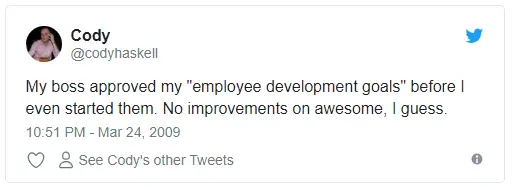
5) What is your opinion on employee development and training?
Have you ever been denied a professional development opportunity, because your own manager said that it would take too much time away from work? Is that why you are thinking of moving roles?
Bad managers ignore professional growth needs, whilst great managers support their staff's ongoing development.
Bonus question to ask
6) How do you delegate tasks?
Do they delegate? Do they micro-manage?
Great managers build trust in their staff. A quick and easy way to do this is to delegate pieces of work, which uses and exploits individuals' strengths, all with the right level of control.
Overall, just remember the interview is two-way. You are interviewing your manager and the company, as well as them interviewing you.
You can ask any questions you want and if you ask the right ones, you won't end up working for an incompetent, bad manager who will make you miserable and your career won't suffer.
Things bad bosses do
Question of the article
Have you ever left an interview saying to yourself “if they don't call me, I won't miss anything”? Tell us in the comments.
What others are saying
- 6 Red Flags That Say Your Boss Is Going To Be A Nightmare
- Top 9 Ways to Spot a Bad Boss
- What was your shortest tenure in a job before walking out and why?
https://www.youtube.com/watch?v=8g1SjbPVlc4
Free BonusIf you want a handy job interview resource that you can keep on your smartphone or print out for easy reference, I’ve got a special bonus for you.
This free download contains:- 165 positive personality adjectives to describe yourself
- 444 of the most popular job interviewer questions to prepare yourself with
- 175 questions that you can ask in job interviews to make a good impression and learn about your future employer

JobMob Insiders can get this free bonus and other exclusive content in the JobMob Insider Bonuses area. Join now, it's free!
Subscribe to JobMob via email and follow me on Twitter for more tips on how to dodge bad warlord bosses.


Some good tips and questions to ask. What if you don’t get interviewed by the manager?
Mel
Mel, I’m curious how Andrew will respond but there’s another article on JobMob that gives an answer to your question:
The Most Important Thing You Can Do to Avoid an Abusive Workplace
Under the “6 Ways to test your next boss” section, most of the headings are not questions and do not require question marks. That is all.
Hi Mel,
Thanks for commenting. It is quire rare not to be interviewed by the person who you will report to. If you aren’t, I would simply ask to see them as you have some questions about how they manage and their management style.
Thanks for observations, Dan.
Andrew
In my department, the first interview is usually by a senior team leader, but a second interview is by either a manager or the department head. So I guess that a good rule of thumb is also not to jump quickly to conclusions, though my immediate reaction to Andrew’s examples (personal mobile conversation) would be to just end the interview and leave.
I agree with most of the suggestions – except that I don’t really see myself asking an interviewer “when did you last praise someone and why?”. Realistically, it seems a bit out of place, no?
Josh / Yehuda
Thanks for commenting.
Josh, I agree with you. If someone acted that way (i.e. personal phone conversation) when interviewing me, I would do the same. Their loss, right?
Yehuda, I agree that specific question can be ‘hard’ to ask. You could just ask it in a different way. Maybe, ‘How do you celebrate success?”. The answer will provide an insight to how the manager praises.
Andrew
Great post! If they don’t smile during the interview, they are not going to smile on the job.
C-Store Guy
Thanks for taking the time out to comment. I agree, a smile makes all the difference.
Andrew
This is a good point. I never thought to put the future potential boss at test like that, although I was always concerned if we are going to work well together or not.
I’ve been lucky to “choose” only good bosses, great managers and leaders. Too bad bosses change after several years: I usually had to resign in such situations, because the new ones were terrible.
Simonne, no one likes to lose a good boss for a bad one. But what if that change gives you the impetus to leave your company for a better position elsewhere?
It’s an unfortunate truth that getting ahead is easier done by switching jobs frequently (and wisely, of course).
This is true, usually the change was for the better (at least in my case). So we can say that bad bosses are an engine for our personal progress, aren’t they?
I had a hard time in uderstanding why companies don’t promote their people, why when a boss is leaving, they usually bring somebody from outside. Then I saw some real life examples which convinced me that most of the times it is better to bring an outsider to fill in the gap.
But when I was in the position of not being promoted, and besides, having to train my new boss on her job, I didn’t feel a strong happiness.
There’s a subtle concept in what you say, and I’ll need to bring it up on JobMob later- the idea that personal progress should be rewarded with a promotion. It seems to make sense but in reality it’s rarely a good idea. To give an example, not many programmers would excel at managing other programmers.
And yes, training your new boss almost always sucks, especially if you wanted their job.
I know in most of the cases it is not a good idea. I’ve seen the best sales representative in a team becoming a lousy sales manager. Even myself, I never promoted somebody from my team, but hired an outsider every time when I was in the situation of filling an opening. It was the right decision, I know it, but my colleagues hated me for that.
Simonne/Jacob,
Great debate.
I have seen many individuals promoted to manager just because of their performance and then fail miserably. The individual is de-motivated and sometimes even demoted or asked to leave the company. That is a failing on the person who actually approved and organised the promotion in the first place!
That does not mean you should not promote from ‘inside’. I always look inside first. You can tell if someone will be a good manager. How well have they built relationships, a network? Do they get people on their side? Are they well organised? Do they get individuals attention when they speak? Etc, etc.
You could always ‘test’ them out by delegated a small ‘project’ for them to lead on and see how they do.
Andrew
Good insights, Andrew.
On the one hand, if employees are qualified for the promotion *and are interested*, then they merit the first look automatically.
On the other hand, companies need to motivate employees differently and avoid the progress = promotion as a default mechanism. Most people would love to have the too-rarely-used notion of salary leveling so that they can continue doing what they do and love best all the while advancing and getting rewarded without having to move into a role that would be uncomfortable for everyone.
Sorry,
tried to embed.
http://en.wikipedia.org/wiki/Peter_principle
Interview is a two-way activity, where both interviewer and interviewee have the chance to decide if they match or not.
However, due to great unemployment pressure, more and more people are kind of lost and make it an one way activity, in which they only see interviewer are choosing interviewee.
Anyway, a good boss means a lot in any people’s career development, so we should always take it seriously.
Thanks for sharing.
Hi! Guess what? I remember also asking similar questions when I used to apply for another job. But since I still cannot find another one until now, I think I know the one of the reasons, that is, giving pressure to the interviewer. But your post is nice, maybe finding the right timing to ask such questions should also be considered.
Pingback: What I Learned From 2007 - Jacob Share | Middle Zone Musings
My mom needs to tell her boss that “abuse is not the way to run an organization”…but unfortunately she is afraid of losing her job so she just remains a “Doormat”. What doe your employees feel about you?
Interesting points. Make sure you pay attention to other red flags during the process. While the interview is very important, keeping your eyes and ears open while waiting is also key. I learned a lot from my last job about interviewing and vowed never to ignore these flags.
In the PR field, I find a great series of questions to ask during the interview revolve around retention and attrition — both on the client-side and employee side. My guess is that this is a question that should be asked in any professional services arena.
If some of these questions don’t make the hiring manager squirm just a little, then dig a little deeper. Selection is a two way street; most candidates ride in the back seat as they interview. Even in today’s environment, a confident candidate will walk away from a mismatch opportunity; they know their days are numbered if they walk in the door.
Pingback: Интервюто за работа - мощен инструмент в ръцете на кандидата | Нова работа
Pingback: Cameron Craig Group
Excellent post. I believe that a good boss is one that becomes the mentor of their employees. They grow and develop their team to be the best that they can be.
Pingback: catch_down
Pingback: Mohammed Al Taee
Pingback: cube_ice
Hi,
Read my umm… “unique” blog/rant about Employers.
http://bobversus.com/2010/03/18/bob-versus-employers/
Pingback: eBossWatch
Pingback: Melissa Cooley
Pingback: Jessica Hunley
Asking those question may send me straight to the unemployment office… =]. If they’re bad bosses, they can smell your defiance. I asked one of the above questions. The guy squirmed, and I didn’t get that job.
My son went into the Aldi store in Erie pa on 12th street to ask how to apply for a District managers position and the manger said “we work hard and its great if your ok working under the leadership of a lesbian seanior manager/director-personally i think its discusting”. My son thanked him and walked out. Aldi hires and promotes the use of slander and what if she was just black? This is not an ok place to Work. My son wrote to the leadership but that manager still works there.
First everyone sit down if you’re not already. I’m part-time currently still. I’ve applied for the full time position 5 times come to find out the fourth time that I applied all of my applications were late?? Really?? Ok moving on 5th time I applied(take for granted I already work at the same place and department I’m applying for) long story short came down to two applicants after second interview process. Not selected. There are to points to this 1 my initial interview went pretty dam close to the one mentioned 2 my manager is a racist f%#*. 98% of the department is black i guess 2 whites is 1 too many. EOE or what people have you ever seen anything like this.
4 times late application and you wonder why you don’t get the job. And then you write disparaging comments ere. Surprised you have a job anymore…..good trolling though
Pingback: How to Smell a Bad Boss in Just One Interview |...
Most important skill ever expressed in a blog post.
Pingback: How To Spot Bad Companies To Work For
Just did a big update to this article 🎉🎉🎉
Over the years I have interviewed to at least 1 job a year within the company I work for.
I was asked how I felt about firing people. I said nope. He then got fired, then I found out he was argumentative, contradictory, illogical, and sinking the ship.
Another job and interview a different boss said, “the hr department posted the job before my approval of its content. The job is not as posted.” ..only to find in conversation later the job”s requirements are duties too dangerous.
Long story short, I realize I have an okay job once a year. ..in a weird way, though. lol
Pingback: 🎸 365 Top Tips to Rock Your Job Search Every Day of 2020